
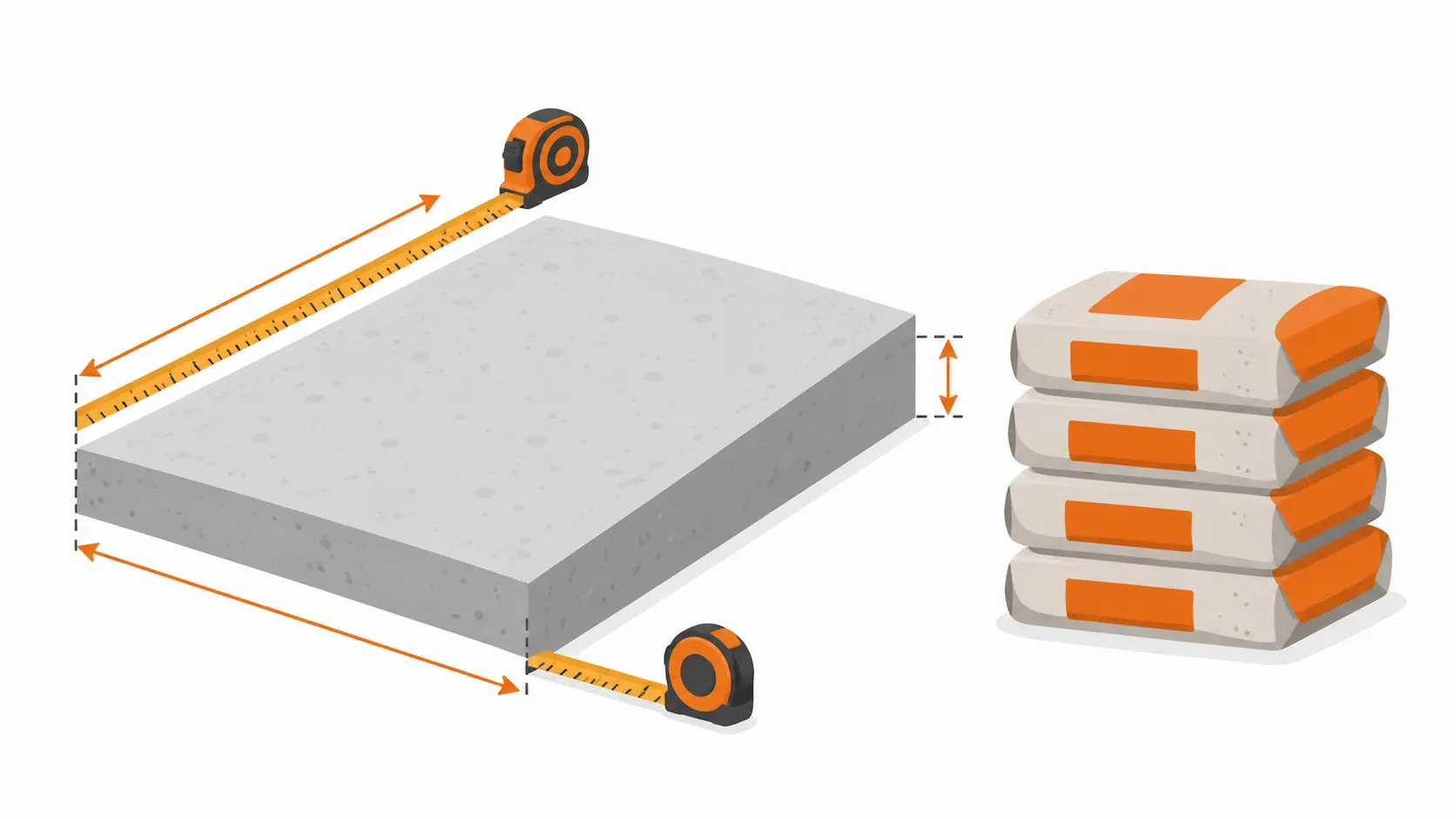
Ordering too little concrete means a delayed, awkward second pour that can compromise the slab’s strength at the seam. Ordering too much wastes money on unused material. Getting the number right the first time matters. Here’s exactly how to calculate it.
The Concrete Volume Formula
Volume (cubic feet) = Length × Width × Depth (all in feet)
Then convert to cubic yards, the standard unit concrete is sold in:
Cubic Yards = Cubic Feet ÷ 27
Real Example: 10ft × 10ft Slab, 4 Inches Thick
Let’s run the numbers for a typical patio slab.
- Length: 10 ft
- Width: 10 ft
- Depth: 4 inches = 4 ÷ 12 = 0.333 ft
Volume: 10 × 10 × 0.333 = 33.3 cubic feet
Cubic yards: 33.3 ÷ 27 = ~1.24 cubic yards
That’s the raw volume needed to fill the slab exactly, before accounting for any waste.
Converting to Bags of Concrete
For smaller DIY projects, bagged concrete is often more practical than ordering ready-mix delivery. A standard 80 lb bag yields approximately 0.6 cubic feet of mixed concrete.
Bags needed: 33.3 ÷ 0.6 = ~56 bags
That’s a lot of bags for a project this size, which is exactly why larger slabs often make more sense with ready-mix delivery instead, covered next.
Ready-Mix vs Bagged Concrete: Which Makes Sense?
- Bagged concrete works well for small projects — fence post footings, small patches, or slabs under roughly 1 cubic yard — since it requires no special delivery scheduling and can be mixed as needed
- Ready-mix delivery becomes more cost-effective and far less labor-intensive once a project exceeds about 1–2 cubic yards, since mixing 56+ bags by hand is genuinely exhausting work, and ready-mix trucks pour the entire volume in minutes
The Concrete Network’s guide to ordering concrete offers a useful rule of thumb: most contractors switch to ready-mix once a project crosses roughly 1 cubic yard, purely for labor efficiency.
Always Add a Waste Factor
Never order the exact calculated amount. Uneven ground, minor spillage, and small measurement errors are unavoidable in real-world pours. Most contractors add a 5–10% waste factor to their calculated volume:
Adjusted volume: 1.24 cubic yards × 1.10 = ~1.36 cubic yards
Adjusted bags: 56 × 1.10 = ~62 bags
Running short mid-pour is a far bigger problem than having a small amount left over, since concrete sets quickly and a delayed second batch can create a visible, weaker seam in the slab. The American Concrete Institute’s guidance on cold joints explains why continuous pours matter structurally, not just cosmetically.
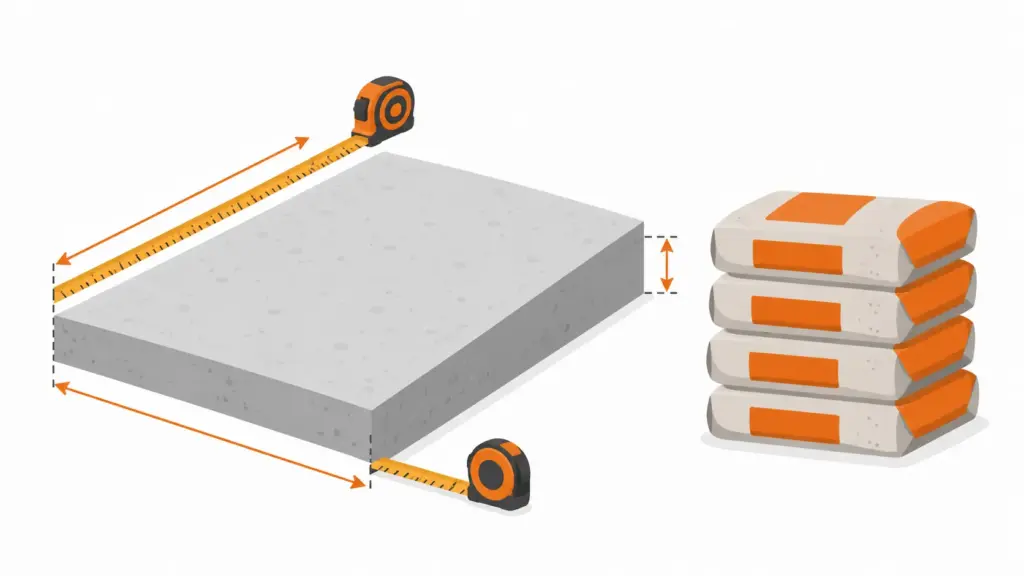
Factors That Affect How Much Concrete You Actually Need
- Uneven or sloped ground — increases actual volume needed beyond the flat-surface calculation, since low spots require extra material
- Rebar or mesh reinforcement — displaces a small amount of volume, though usually not enough to significantly change your order
- Curved or irregular shapes — require breaking the area into simpler shapes (rectangles, triangles) and calculating each separately, then adding the volumes together
Calculate your exact concrete needs. Use the Concrete Calculator →
Frequently Asked Questions
How many bags of concrete do I need for a 10×10 slab?
For a 10×10 slab at 4 inches thick, you’d need approximately 56 bags of 80 lb concrete mix before adding a waste factor, or roughly 62 bags after adding a typical 10% overage allowance.
How thick should a concrete slab be?
Standard patio or walkway slabs are typically 4 inches thick, while driveways supporting vehicle weight usually require 5–6 inches, and heavier commercial applications may need even more depth depending on expected load.
Is it cheaper to buy bagged concrete or ready-mix?
For small projects, bagged concrete is often cheaper due to no delivery minimums or fees. For larger projects, typically over 1–2 cubic yards, ready-mix delivery usually becomes more cost-effective once labor time and bag quantity are factored in.
How much waste factor should I add to a concrete order?
Most contractors recommend adding 5–10% extra to your calculated volume, accounting for uneven ground, minor spillage, and measurement variance, since running short mid-pour is a much bigger problem than having a small surplus.
How long does concrete take to cure?
Concrete typically reaches enough strength to walk on within 24–48 hours, but full curing strength generally takes about 28 days, which is why heavy loads (like driving a car on a new driveway) should be avoided until that full curing period passes.
Can I mix concrete by hand for a large project?
Technically yes, but it’s rarely practical. Mixing 50+ bags by hand is extremely labor-intensive and time-consuming, and the risk of the earlier-poured sections beginning to set before you finish increases significantly, making ready-mix delivery the more practical choice for larger pours.