
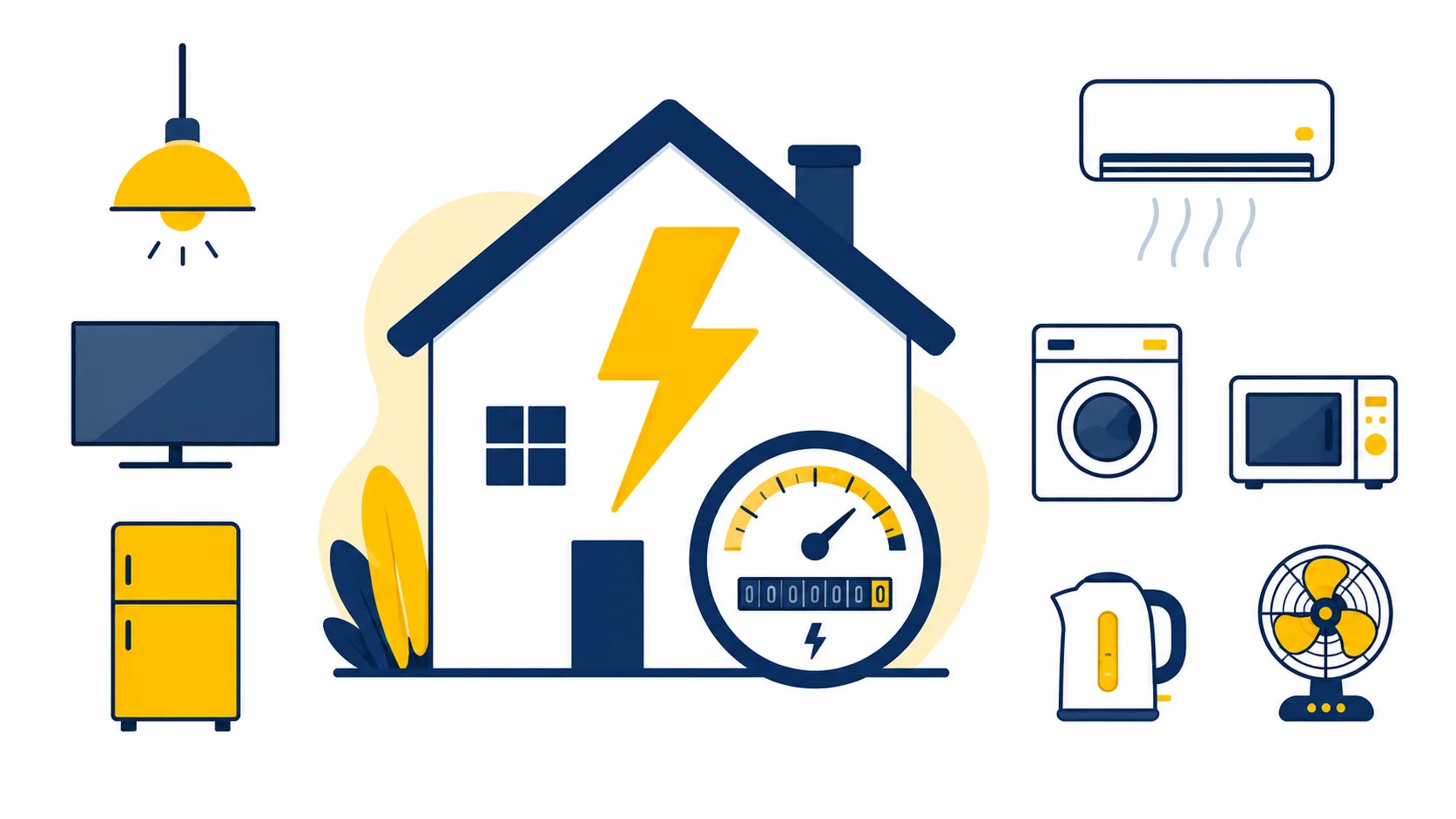
Your electric bill lists a total, but almost never breaks down which appliances actually drove that number up. Once you know the formula, you can calculate the cost of running anything in your home, and spot exactly where the money is going.
The Electricity Cost Formula
Cost = (Watts ÷ 1,000) × Hours Used × Electricity Rate (per kWh)
Electricity is billed in kilowatt-hours (kWh), which is why watts need to be divided by 1,000 first, converting them into kilowatts before multiplying by hours and rate.
Real Example: Air Conditioner, 1,500W, 8 Hours/Day
Let’s calculate.
- Appliance wattage: 1,500W
- Hours used per day: 8
- Electricity rate: $0.15 per kWh
Daily energy use: (1,500 ÷ 1,000) × 8 = 12 kWh/day
Daily cost: 12 × $0.15 = $1.80
Monthly cost (30 days): $1.80 × 30 = $54.00
That single appliance, run consistently through a warm month, adds $54 to the bill on its own, which explains why air conditioning is consistently one of the largest line items in summer electric bills.
Common Appliance Wattage Reference
Wattage varies by specific model, but rough typical ranges include:
| Appliance | Typical Wattage |
|---|---|
| Central air conditioner | 3,000–3,500W |
| Window AC unit | 500–1,500W |
| Refrigerator | 100–800W (cycles on/off) |
| Electric water heater | 4,000–4,500W |
| Space heater | 1,500W |
| LED light bulb | 8–12W |
| Washing machine | 350–500W |
| Clothes dryer | 1,800–5,000W |
The US Department of Energy’s appliance energy use guide has more complete reference ranges by appliance type.
How to Read Your Electric Bill Rate
Your electric bill shows a rate per kWh, though the exact structure varies by utility. Some charge a flat rate regardless of usage. Others use tiered rates, where the price per kWh increases once you cross certain usage thresholds. Time-of-use rates charge different prices depending on when electricity is used, often cheaper overnight and pricier during peak afternoon hours. The US Energy Information Administration’s average rate data shows how rates vary significantly by state and utility provider.
Practical Tips to Reduce Your Electricity Cost
- Run high-wattage appliances during off-peak hours if your utility uses time-of-use pricing, since the same usage costs less at certain times
- Switch to LED lighting, since LEDs use roughly 75% less energy than incandescent bulbs for the same brightness
- Set your water heater to 120°F instead of higher default settings, cutting standby energy loss without a noticeable comfort difference
- Clean or replace HVAC filters regularly, since a clogged filter forces the system to work harder and use more electricity for the same cooling or heating output
- Unplug devices with standby power draw, covered in more detail below
Phantom Power: The Hidden Cost of “Off” Devices
Many devices draw a small amount of power even when switched off, as long as they’re plugged in. This is often called phantom or vampire power. Game consoles, TVs, phone chargers, and many kitchen appliances with digital clocks or standby modes all fall into this category. The Lawrence Berkeley National Laboratory’s standby power research estimates phantom power can account for a meaningful, though often underestimated, share of a typical household’s total electricity use.
Calculate the exact cost of any appliance. Use the Electricity Cost Calculator →
Frequently Asked Questions
How do I calculate how much electricity costs to run something?
Divide the appliance’s wattage by 1,000 to convert to kilowatts, multiply by the hours used, then multiply by your electricity rate per kWh. This gives the exact cost for that specific usage period.
What appliances use the most electricity?
Heating and cooling systems, electric water heaters, and clothes dryers typically use the most electricity in a household, since they combine high wattage with relatively long or frequent run times compared to smaller electronics.
How much does it cost to run an AC unit all day?
It depends heavily on the unit’s wattage and your electricity rate, but a central AC system running 3,200W for 10 hours a day at $0.15/kWh costs roughly $4.80/day, or about $144 over a 30-day month.
Does unplugging devices actually save money?
Yes, though usually a modest amount per device. Devices with standby power draw (phantom power) collectively can add up to a meaningful portion of a household’s electric bill, making unplugging rarely-used electronics a small but genuine savings habit.
What is a kilowatt-hour?
A kilowatt-hour (kWh) is the standard unit electricity is billed in, representing the energy used by a 1,000-watt device running for one hour, or equivalently, a 500-watt device running for two hours.
How can I lower my electric bill without buying new appliances?
Adjusting thermostat settings, using appliances during off-peak hours if applicable, switching to LED bulbs, cleaning HVAC filters regularly, and unplugging standby devices are all effective changes that require no new equipment purchases.