
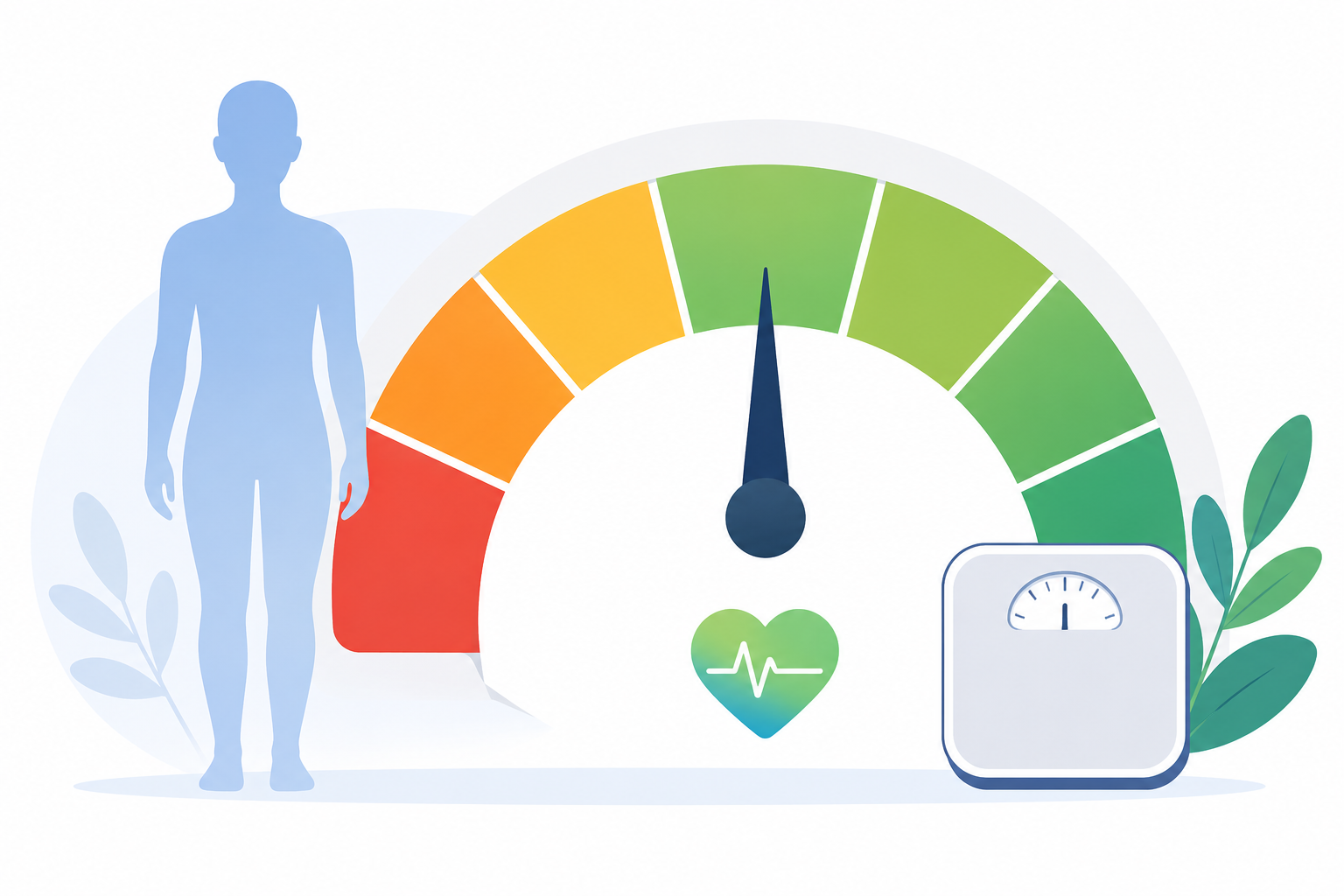
Body Mass Index — BMI — is one of the most widely used health metrics in the world, referenced by doctors, insurance companies, and fitness apps alike. It’s also one of the most misunderstood. Knowing your number is useful, but knowing what it actually does and doesn’t tell you is even more important.
Here’s how BMI is calculated, what the categories mean, and what a realistic, healthy path forward looks like.
How to Calculate BMI (Imperial and Metric)
Imperial formula: BMI = [weight (lb) ÷ height (in)²] × 703
Metric formula: BMI = weight (kg) ÷ height (m)²
Real example: A 175 lb man who is 5’10” (70 inches) tall:
BMI = (175 ÷ 70²) × 703 = (175 ÷ 4,900) × 703 = 25.1
That places him just barely into the “overweight” category, illustrating how close BMI’s category cutoffs really are — a couple of pounds either way can shift the label entirely.
BMI Categories Explained
- Underweight: below 18.5
- Normal weight: 18.5 – 24.9
- Overweight: 25 – 29.9
- Obese Class I: 30 – 34.9
- Obese Class II: 35 – 39.9
- Obese Class III: 40 and above
These ranges are used broadly across public health guidelines, but they were never designed to be a precise individual diagnostic tool — more on that next.
Limitations of BMI (What It Doesn’t Tell You)
BMI has one major blind spot: it can’t distinguish between muscle and fat. A muscular athlete with low body fat can register as “overweight” or even “obese” on the BMI scale simply because muscle is denser than fat. BMI also doesn’t account for:
- Age — muscle mass naturally declines with age, so the same BMI can represent very different body compositions at 25 vs. 65.
- Sex — women typically carry a higher percentage of body fat than men at the same BMI.
- Ethnicity — some health organizations use adjusted BMI thresholds for certain populations, since health risk at a given BMI can vary by ethnic background.
For these reasons, BMI is best used as a quick screening tool, not a standalone diagnosis — waist circumference, body fat percentage, and overall health markers (blood pressure, cholesterol, blood sugar) give a much fuller picture.
What a Healthy BMI Looks Like by Age Group
While the standard 18.5–24.9 “normal” range is generally used for all adults, many clinicians note that the ideal range can shift modestly with age — some research suggests a BMI slightly above the traditional “normal” cutoff may carry less added risk for older adults compared to younger adults, which is part of why doctors weigh BMI alongside other health markers rather than in isolation, especially for people over 65.
How to Move from Overweight to Healthy BMI Realistically
Say the 175 lb, 5’10” man from our example wants to move from a BMI of 25.1 down to 24.0 (solidly “normal” range). That would require losing about 8 lbs.
At a safe, sustainable rate of 0.5–1 lb per week (created through a 250–500 calorie daily deficit), that’s roughly 8–16 weeks — a realistic, non-extreme timeline that’s far more sustainable than crash dieting.
Find your exact BMI in seconds. Calculate Your BMI Now →
Frequently Asked Questions
Is BMI 25 considered overweight?
Yes — under standard adult BMI classifications, a BMI of 25.0 to 29.9 falls into the “overweight” category, while 18.5 to 24.9 is considered “normal weight.”
What BMI is considered obese?
A BMI of 30 or above is classified as obese, further broken into Class I (30–34.9), Class II (35–39.9), and Class III (40+), which is sometimes referred to as severe obesity.
How accurate is BMI?
BMI is a useful population-level screening tool but has known limitations at the individual level, since it can’t distinguish muscle from fat and doesn’t account for age, sex, or body composition differences.
What is the ideal BMI for women?
The same general “normal” range of 18.5–24.9 is typically used for adult women and men, though individual health, body composition, and other risk factors matter more than the BMI number alone.