
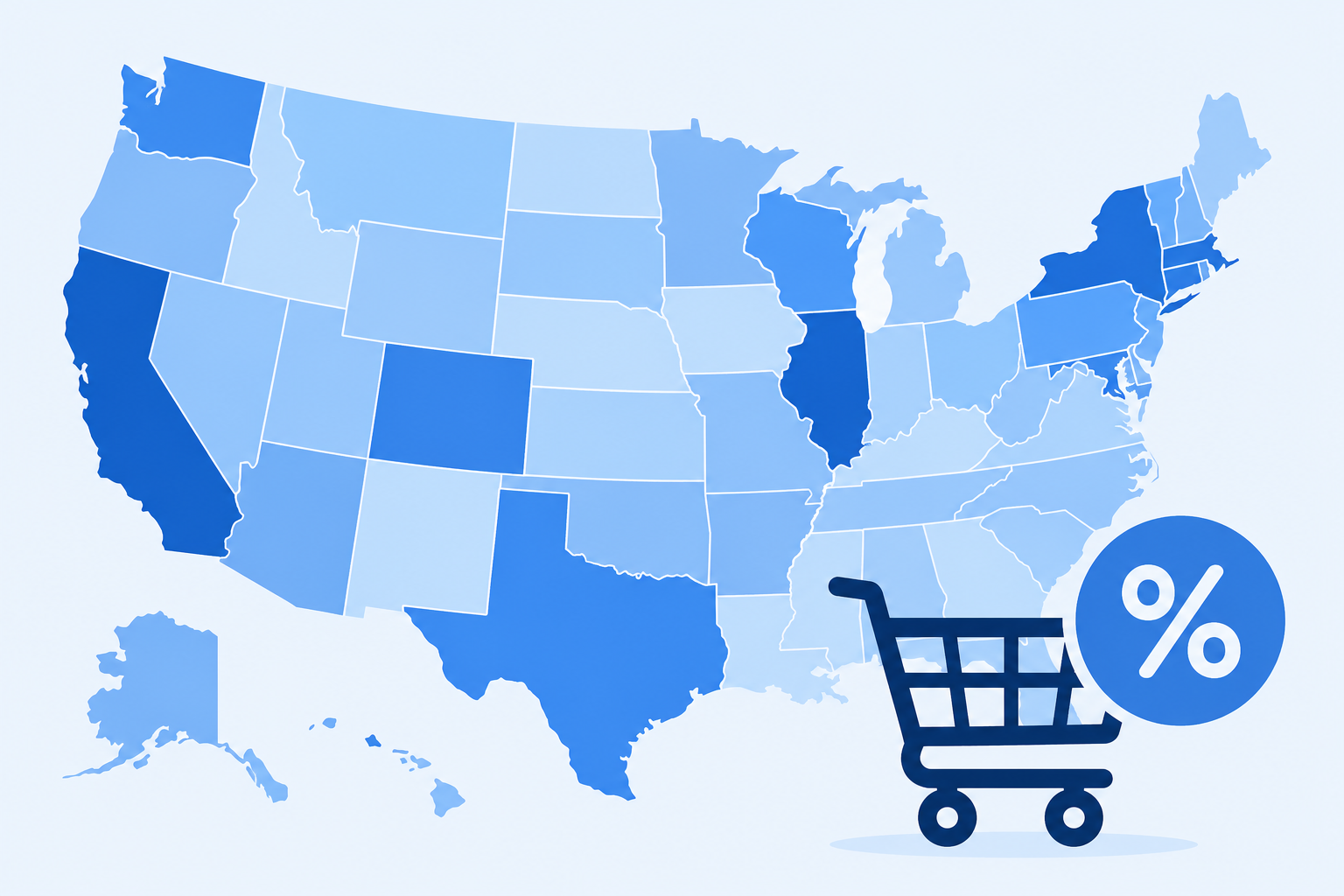
Unlike VAT or GST used in most of the world, the United States has no single national sales tax — instead, 45 states plus Washington DC each set their own rate, and many cities and counties layer additional local tax on top. That patchwork is exactly why the “$20 item” you’re buying rarely costs exactly $20 at checkout.
Here’s how to calculate it correctly, wherever you’re shopping or selling.
How to Calculate Sales Tax (The Formula)
Tax = Price × (Tax Rate ÷ 100)
Example: A $150 item in California, where the combined state and average local rate is roughly 8.68%:
$150 × 0.0868 = $13.02 tax
Total price: $163.02
Highest and Lowest Sales Tax States in 2025
According to Tax Foundation’s state sales tax data, combined state and average local sales tax rates vary enormously:
Highest combined rates:
- Louisiana (~9.5%+)
- Tennessee (~9.5%+)
- Arkansas (~9.4%+)
No state sales tax at all:
- Oregon
- Montana
- New Hampshire
- Delaware
- Alaska (though some Alaska localities do charge local sales tax)
That means the exact same $150 purchase could cost you $150 in Oregon or over $164 in Louisiana — a meaningful difference for larger purchases. Bankrate’s state-by-state sales tax breakdown is a handy reference before a big purchase.
Combined State + Local Sales Tax Rates — What You Actually Pay
The rate posted at checkout is almost always a combination of state, county, and sometimes city-level tax. Avalara’s sales tax learning center offers detailed lookup tools since these combined rates can vary block by block in some jurisdictions, especially near county or city borders.
Online Sales Tax After the Wayfair Decision (2018)
Before 2018, online retailers generally only had to collect sales tax in states where they had a physical presence. The Supreme Court’s South Dakota v. Wayfair decision changed that, allowing states to require tax collection based on “economic nexus” — meaning a certain volume of sales into a state, even without a physical location there. This is why most online checkouts now calculate sales tax automatically based on your shipping address, regardless of where the seller is based.
Reverse Sales Tax — How to Calculate Pre-Tax Price from Total
If you know the total (tax-included) price and need the original amount:
Original Price = Total Price ÷ (1 + Tax Rate ÷ 100)
Example: A $163.02 total at an 8.68% rate:
$163.02 ÷ 1.0868 = $150.00 original price
Sales Tax for Business Owners — Collection and Filing
If you sell physical goods (and in many states, certain services), you’re generally required to:
- Register for a sales tax permit in states where you have nexus
- Collect the correct rate based on the buyer’s location (destination-based) or your business location (origin-based), depending on the state
- File and remit collected sales tax on a schedule set by each state — monthly, quarterly, or annually depending on sales volume
The IRS’s guidance on sales and use tax is a useful starting point, though sales tax itself is administered at the state level, not federally.
Calculate sales tax instantly for any US state. Use the Sales Tax Calculator →
Frequently Asked Questions
Which states have no sales tax?
Oregon, Montana, New Hampshire, Delaware, and Alaska have no statewide sales tax, though Alaska allows local jurisdictions to charge their own sales tax.
What is the average US sales tax?
Combined state and average local sales tax rates across the US generally range from around 6% to 9.5%, though this varies significantly by state and even by city or county within the same state.
Do you pay sales tax on online purchases?
Generally yes. Since the 2018 Wayfair Supreme Court decision, most online retailers are required to collect sales tax based on the buyer’s shipping address, even if the seller has no physical presence in that state.
Is sales tax deductible?
For individuals who itemize deductions, state and local sales tax can be deducted instead of state income tax (not both), subject to the overall SALT deduction cap. Businesses can generally deduct sales tax paid on business purchases as a cost of doing business.