
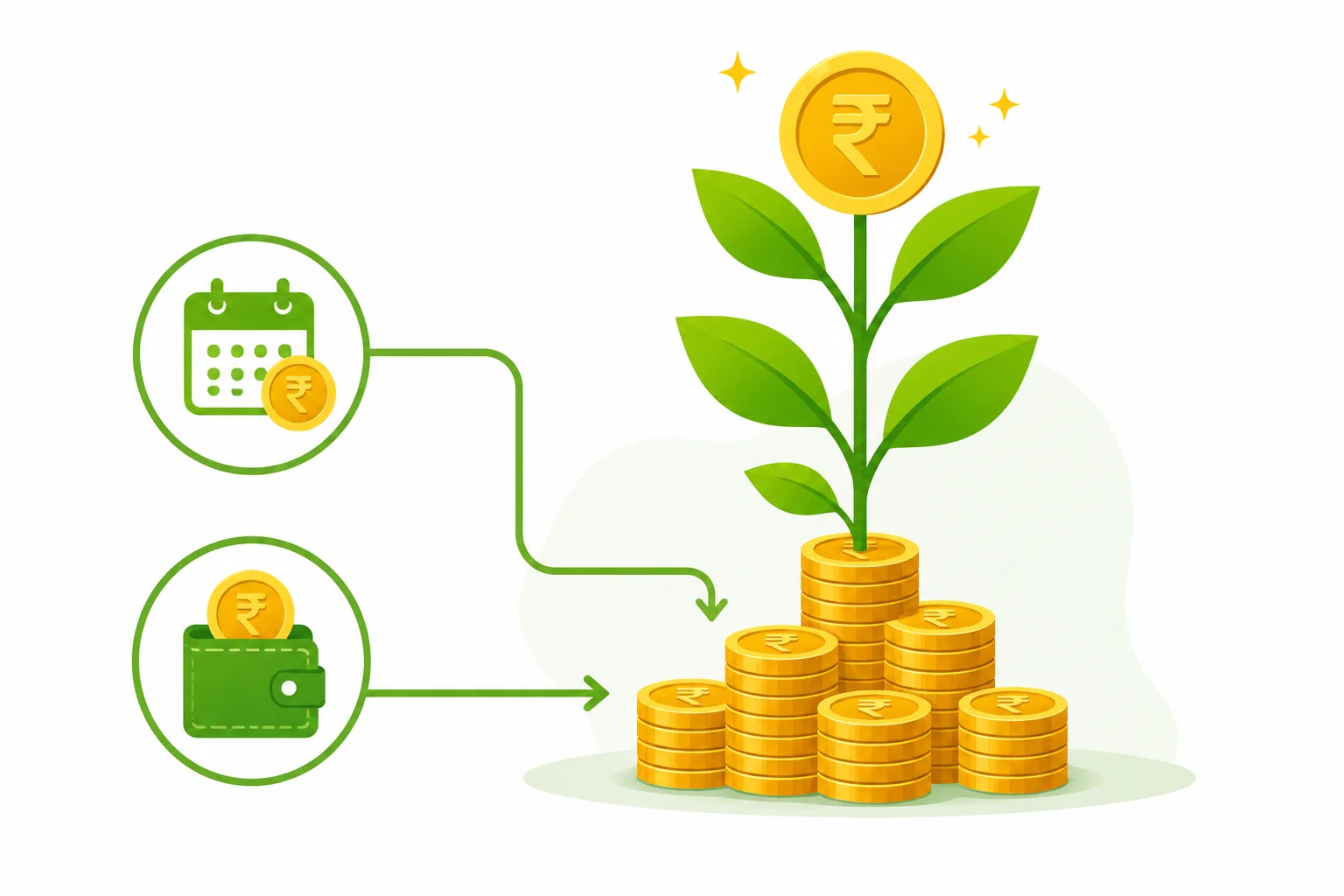
Most people invest in two ways at once. They start with some savings. Then they add to it over time. Yet most online calculators only handle one or the other. Here’s how to model both together, with a real example showing exactly what that combination can grow into.
The Combined Growth Formula
Total future value comes from adding two separate calculations together:
1. Lump Sum Growth: FV = P × (1 + r)^t
2. Monthly Contribution Growth: FV = PMT × [((1 + r/12)^(12t) − 1) / (r/12)]
Add both results together, and you get your total projected balance.
Real Example: $5,000 Lump Sum + $200/Month for 20 Years
Let’s run the numbers at an 8% average annual return.
Lump sum growth: $5,000 × (1.08)^20 = $23,305
Monthly contribution growth: $200/month, compounded monthly at 8% annually, over 240 months = $117,860
Total projected balance: $23,305 + $117,860 = ~$141,165
That’s the power of combining both approaches. The monthly contributions actually contribute more to the final number than the original lump sum. That’s despite starting from zero. Consistency compounds just as powerfully as a big head start.
Lump Sum vs Dollar-Cost Averaging (DCA)
Say you had $20,000 to invest today. Should you put it all in at once, or spread it out over 12 months?
Historically, investing a lump sum immediately tends to outperform DCA, since markets trend upward over long periods more often than they decline. But DCA carries a real psychological benefit: it smooths out the emotional impact of investing right before a downturn, which can help investors stay the course rather than panic-sell.
Neither approach is “wrong.” The math slightly favors lump sum on average. But DCA can be the better choice if it’s what keeps you actually investing instead of sitting in cash out of fear.
How Asset Allocation Changes Your Growth Rate
The 8% return used in our example isn’t guaranteed. It depends heavily on your asset allocation. A portfolio weighted toward stocks has historically returned more over long periods than one weighted toward bonds, but with more short-term volatility along the way. Investopedia’s guide to asset allocation covers how mixing stocks, bonds, and other assets shifts your expected return and risk profile together.
Tax-Advantaged vs Taxable Accounts
Where you hold your investments matters almost as much as what you invest in.
- Tax-advantaged accounts (401(k), IRA) let your money grow without annual tax drag on dividends or capital gains, which meaningfully boosts long-term compounding
- Taxable brokerage accounts offer more flexibility and no contribution limits, but dividends and realized gains get taxed along the way, slightly reducing the effective compounding rate
Most financial advisors recommend maxing out tax-advantaged space first, then using taxable accounts for money beyond those limits. The IRS’s retirement plan contribution limits page has the current annual caps for reference.

Rebalancing: Keeping Your Allocation on Track
Over time, strong-performing assets grow to make up a larger share of your portfolio than originally intended. Rebalancing means periodically selling a portion of the winners and buying more of the laggards, to bring your allocation back to your target mix. Most investors rebalance annually or when an asset class drifts more than 5% from its target weight. Schwab’s guide to portfolio rebalancing explains both time-based and threshold-based approaches in more depth.
Model your own lump sum plus monthly contribution growth. Use the Investment Calculator →
Frequently Asked Questions
How much will $10,000 grow in 10 years?
At a 7% average annual return with no additional contributions, $10,000 would grow to approximately $19,672 in 10 years. At a 10% return, it would grow to roughly $25,937, though actual market returns vary and aren’t guaranteed.
Is it better to invest a lump sum or invest monthly?
Historically, investing a lump sum immediately has outperformed spreading it out over time, simply because markets trend upward more often than they decline. That said, monthly investing (dollar-cost averaging) can reduce emotional stress and help investors stick with their plan.
What is a realistic average annual return for investing?
Many long-term investors use 7–10% as a realistic average annual return estimate for a diversified stock-heavy portfolio, based on historical long-term market performance, though returns vary significantly year to year and aren’t guaranteed going forward.
How much should I invest monthly to become a millionaire?
It depends heavily on your timeline and expected return, but as an example, investing $500/month at an 8% average annual return would grow to roughly $1 million in about 33 years, starting from zero.
Should I pay off debt before investing?
It generally depends on the interest rate on your debt. High-interest debt, like credit cards, usually costs more than typical investment returns, so paying that down first often makes more financial sense than investing simultaneously.
Does compounding frequency matter for investment growth?
It matters less than most people expect. The investment return rate and the length of time invested matter far more than whether growth compounds monthly, quarterly, or annually, since the difference between compounding frequencies is typically small over long periods.