
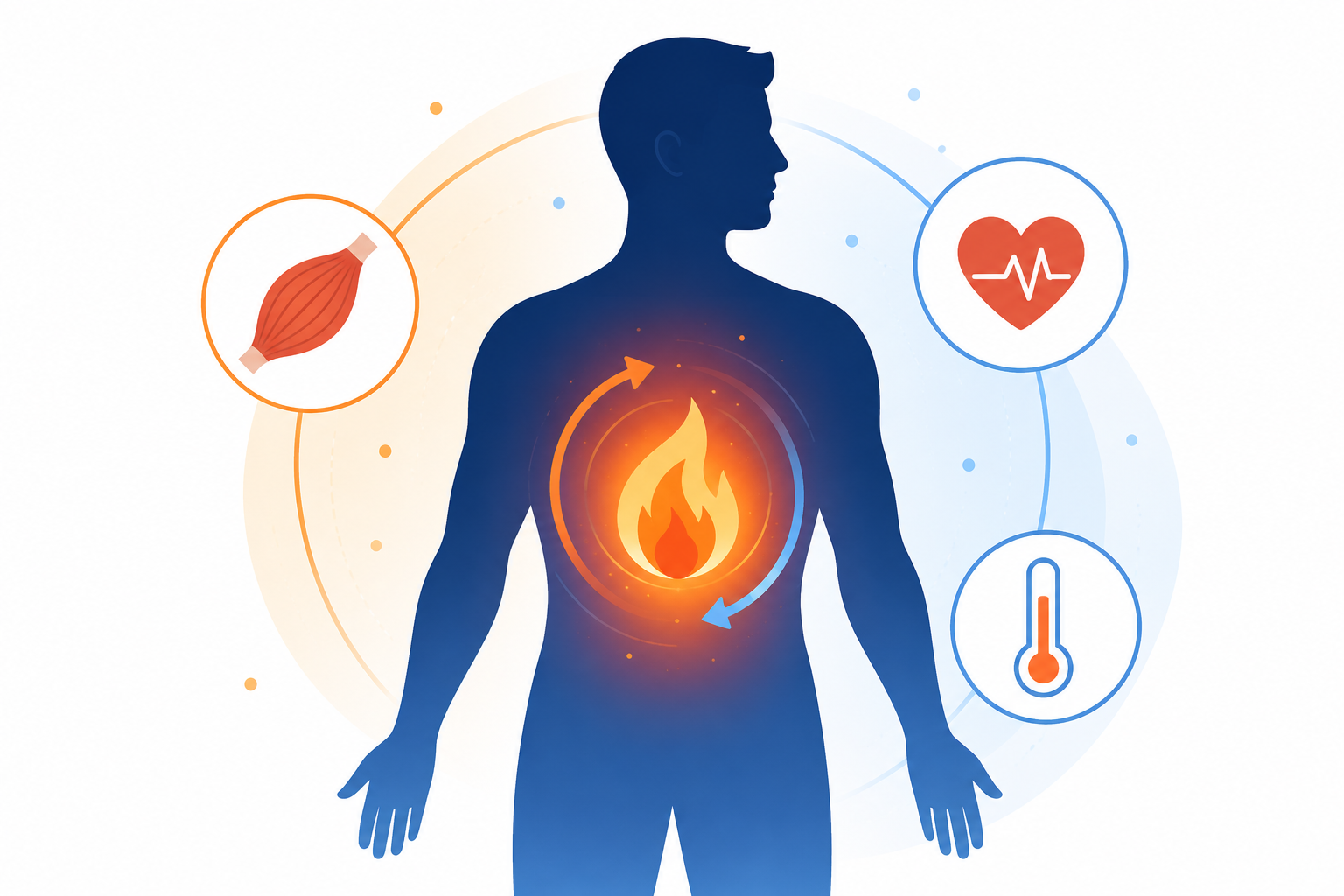
“Metabolism” gets blamed for a lot — weight loss plateaus, weight gain, feeling tired — but very few people actually know their own number. BMR, or Basal Metabolic Rate, is that number: the amount of energy your body burns just to stay alive, before you take a single step or eat a single meal. It’s the foundation every other calorie calculation is built on.
What Is BMR (Basal Metabolic Rate)?
BMR represents the calories your body needs for essential functions at complete rest — breathing, circulating blood, maintaining body temperature, and cell production. It typically accounts for 60–75% of total daily calorie burn in a sedentary person, which is why understanding it matters so much for anyone managing their weight. The National Institutes of Health’s overview of energy expenditure breaks down how BMR fits into the broader picture of daily energy needs.
The Mifflin-St Jeor Formula (Most Accurate Modern Method)
Most nutrition professionals now favor the Mifflin-St Jeor equation over older formulas, since research has shown it’s more accurate for modern populations:
- Men: BMR = 10 × weight(kg) + 6.25 × height(cm) − 5 × age + 5
- Women: BMR = 10 × weight(kg) + 6.25 × height(cm) − 5 × age − 161
How Mifflin-St Jeor Compares to Harris-Benedict
The older Harris-Benedict equation, developed in 1919 and revised in 1984, was the standard for decades and is still used by some calculators today. It follows a similar structure but tends to slightly overestimate BMR compared to Mifflin-St Jeor, particularly for people who are overweight. Most modern clinical and fitness guidance, including resources from the Academy of Nutrition and Dietetics, now recommends Mifflin-St Jeor as the more reliable default.
Real BMR Example: 140 lb Woman, 5’4″, Age 26
Let’s calculate:
- Weight: 140 lb ≈ 63.5 kg
- Height: 5’4″ ≈ 162.6 cm
- Age: 26
BMR = 10(63.5) + 6.25(162.6) − 5(26) − 161 BMR = 635 + 1,016 − 130 − 161 = ~1,360 calories/day
That’s the number of calories her body burns at complete rest — before any walking, exercise, or daily activity is factored in. To get her full daily calorie need (TDEE), this BMR would then be multiplied by an activity factor, exactly as covered in our TDEE calculator guide.
What Actually Affects Your BMR
- Muscle mass — muscle tissue burns more calories at rest than fat tissue, which is why strength training can meaningfully raise BMR over time
- Age — BMR naturally declines with age, largely due to gradual muscle loss (sarcopenia) unless actively counteracted through resistance training
- Genetics — some individual variation in BMR exists between people of identical height, weight, and age, though the effect is generally smaller than popular belief suggests
- Hormonal factors — thyroid function in particular has a significant effect on metabolic rate; conditions like hypothyroidism can meaningfully lower BMR
- Body composition — two people at the same total weight but different muscle-to-fat ratios will typically have somewhat different BMRs
Common BMR and Metabolism Myths
- “Starvation mode” from skipping one meal — a single missed meal does not meaningfully slow metabolism; sustained, severe calorie restriction over weeks can, but this is a very different scenario than typical dieting
- Certain foods “boost” metabolism significantly — while foods like spicy peppers or green tea have small, measurable thermogenic effects, the impact on total daily calorie burn is minor compared to muscle mass and activity level
- Metabolism is fixed and unchangeable — while genetics play a role, BMR responds meaningfully to changes in muscle mass, making strength training one of the more reliable long-term levers available
The Mayo Clinic’s metabolism myths and facts guide is a good resource for separating fitness-industry marketing claims from what actual research supports.
How BMR Relates to TDEE and Weight Management
BMR is the starting point, not the finish line. Your Total Daily Energy Expenditure (TDEE) — the number that actually matters for weight loss, maintenance, or gain — is calculated by multiplying BMR by an activity multiplier reflecting how active you are day to day. Confusing the two is a common mistake: eating exactly at your BMR (rather than your full TDEE) creates an extreme, often unsustainable calorie deficit, since it ignores all the energy you burn through actual daily movement and exercise.
Find your exact BMR in seconds. Use the BMR Calculator →
Frequently Asked Questions
What is a normal BMR for my age?
There’s no single “normal” BMR — it depends on your weight, height, age, sex, and body composition. A useful reference point is that BMR typically ranges from around 1,200–1,800 calories/day for most adult women and 1,500–2,200 for most adult men, though individual results vary.
Is a higher BMR better?
A higher BMR generally means you burn more calories at rest, which can make weight management somewhat easier, but BMR isn’t something to chase for its own sake — it’s simply one input into your total calorie needs, alongside activity level and diet quality.
How can I increase my BMR?
Building muscle through resistance training is the most reliable, evidence-based way to meaningfully raise BMR over time, since muscle tissue burns more calories at rest than fat tissue. Adequate protein intake and sufficient sleep also support metabolic health, though their direct effect on BMR is smaller than muscle mass.
Does BMR decrease with age?
Yes, BMR typically declines gradually with age, largely due to natural muscle loss that begins in a person’s 30s and accelerates further without regular resistance training — this is one of the most consistent, well-documented BMR trends in research.
Is BMR the same as TDEE?
No. BMR is the calories your body burns at complete rest, while TDEE (Total Daily Energy Expenditure) adds in the calories burned through daily activity and exercise. TDEE is typically 20–90% higher than BMR, depending on activity level.
Which BMR formula is most accurate?
The Mifflin-St Jeor equation is generally considered the most accurate for the general population today, having replaced the older Harris-Benedict formula in most modern clinical and fitness settings, though body composition-based formulas (using lean body mass) can be even more precise for athletic individuals.