
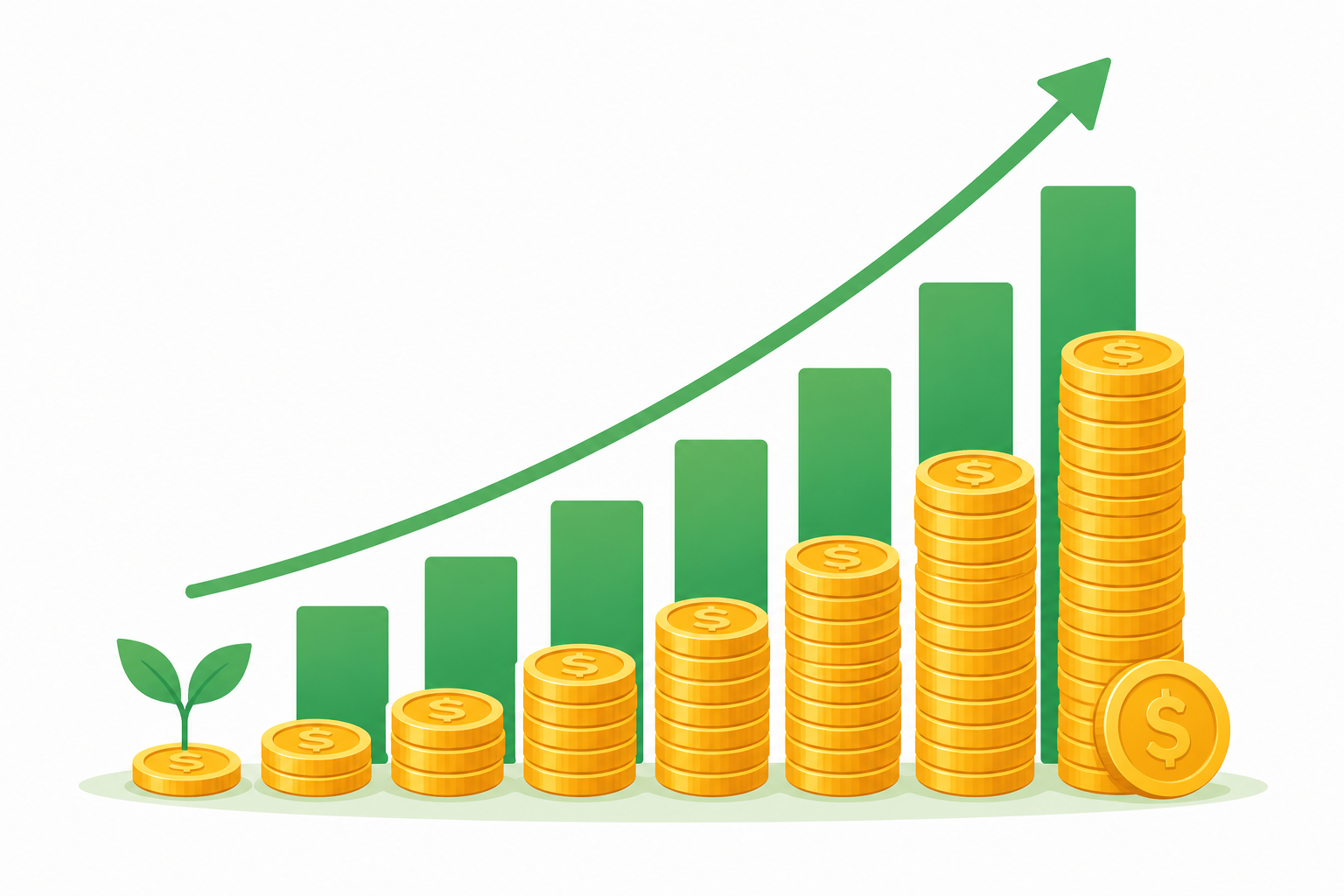
Albert Einstein is often (perhaps apocryphally) credited with calling compound interest “the eighth wonder of the world.” Whether or not he actually said it, the sentiment holds up: compounding is the single most powerful — and most underused — tool available to everyday savers and investors.
Here’s exactly how it works, the math behind turning $10,000 into $100,000, and how to use it to your advantage starting today.
The Compound Interest Formula Explained
The standard compound interest formula is:
A = P (1 + r/n)^(nt)
Where:
- A = the final amount
- P = your starting principal
- r = annual interest rate (as a decimal)
- n = number of times interest compounds per year
- t = number of years invested
The key insight is that unlike simple interest — which only pays you on your original principal — compound interest pays you interest on your interest, which is what creates the exponential curve that makes long-term investing so powerful.
$10,000 → $100,000: A Real Compound Growth Example
Let’s see how long it actually takes to turn $10,000 into $100,000 at different annual returns, assuming interest compounds annually with no additional contributions.
| Growth Rate | Value After 20 Years | Value After 25 Years | Value After 30 Years |
|---|---|---|---|
| 7% | $38,697 | $54,274 | $76,123 |
| 8% | $46,610 | $68,485 | $100,627 |
| 10% | $67,275 | $108,347 | $174,494 |
A few takeaways jump out immediately:
- At a 7% return, $10,000 doesn’t quite reach $100,000 even after 30 years — it takes closer to 34 years.
- At 8%, you cross the $100,000 mark right around the 30-year mark.
- At 10%, you blow past $100,000 in about 24 years.
That three-percentage-point difference between 7% and 10% adds nearly a full decade of “wait time” to reach the same goal — which is exactly why fees, asset allocation, and time in the market matter so much over long horizons.
Daily vs Monthly vs Yearly Compounding — What’s the Difference?
The “n” in the formula — how often interest compounds — does make a difference, though usually a smaller one than most people expect. On a $10,000 balance at 8% over 20 years:
- Compounded annually: ~$46,610
- Compounded monthly: ~$49,268
- Compounded daily: ~$49,527
More frequent compounding modestly increases your return, but the rate itself and the length of time invested matter far more than compounding frequency.
The Role of Regular Contributions (Not Just Lump Sum)
The table above assumes a single lump-sum deposit with nothing added afterward — but very few people actually invest that way. Add regular monthly contributions, and the growth accelerates dramatically.
For example, that same $10,000 at 8% annual return, with an additional $300 contributed every month, would grow to roughly $187,000 in 20 years instead of $46,610 — because you’re compounding both your original principal and every new contribution along the way.
This is the real lesson behind compound interest: it’s not just about picking a good rate, it’s about combining a decent rate with consistent contributions and time.
5 Accounts Where Compound Interest Works Hardest
- High-Yield Savings Accounts (HYSA) — lower returns, but safe and liquid; ideal for emergency funds.
- 401(k) Plans — tax-advantaged growth, often with an employer match that’s effectively free compounding.
- Roth and Traditional IRAs — long-term tax-advantaged compounding with more investment flexibility than most 401(k)s.
- Index Funds (Taxable Brokerage) — historically averaged 8–10% annually over multi-decade periods, though returns are never guaranteed.
- Certificates of Deposit (CDs) — fixed, predictable compounding for money you won’t need for a set period.
Try our free Compound Interest Calculator to model your exact scenario, rate, and contribution amount: quikcalctools.com/compound-interest-calculator
Frequently Asked Questions
How much will $1,000 grow in 10 years?
At a 7% annual return compounded yearly, $1,000 grows to roughly $1,967 in 10 years. At 10%, it grows to about $2,594. The exact figure depends on the rate, compounding frequency, and whether additional contributions are made.
Is compound interest better than simple interest?
For savers and investors, yes — compound interest grows your money faster over time because you earn returns on both your principal and your accumulated interest, rather than principal alone.
What is the best account for compound interest?
It depends on your goal and timeline. Tax-advantaged retirement accounts (401(k), IRA) are typically best for long-term growth, while high-yield savings accounts or CDs suit shorter-term, lower-risk goals.
Does compounding really make a big difference?
Yes, especially over long periods. The gap between a 7% and 10% return might look small year to year, but compounded over 20–30 years it can mean tens or even hundreds of thousands of dollars in difference on the same starting amount.