
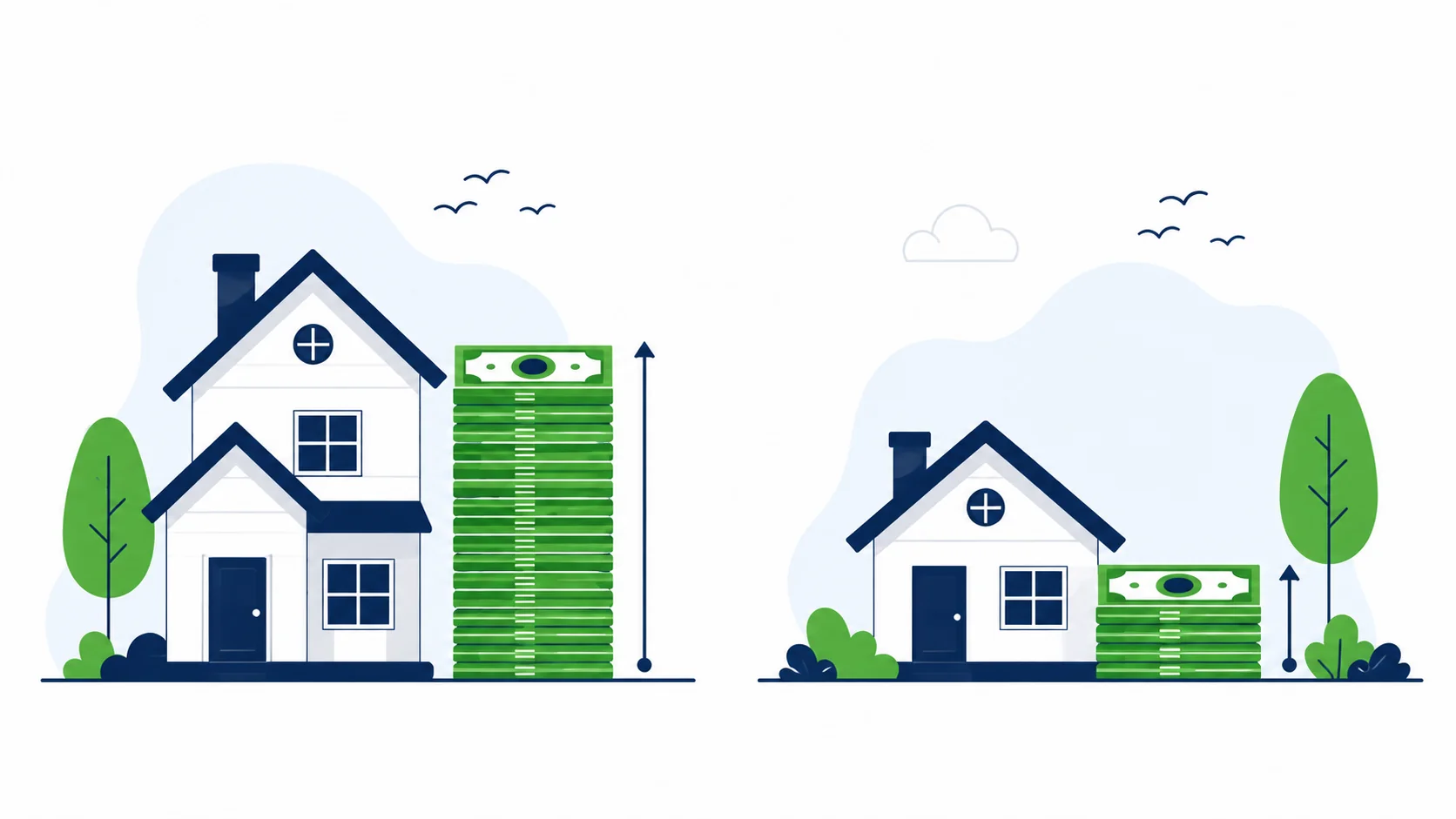
This is one of the biggest decisions in the entire home-buying process. Yet most buyers pick their term almost automatically. They just default to 30 years, since it’s the most common option. But the real numbers tell a more interesting story. Let’s look at exactly what each term costs, in dollars.
The Core Trade-Off
A 15-year mortgage means higher monthly payments. But you pay far less interest overall, and you build equity much faster. A 30-year mortgage spreads payments out, keeping your monthly cost lower. But that convenience comes at a real price, paid in extra interest over time.
Real Example: $350,000 Loan
Let’s compare both terms side by side, using typical current rates, where 15-year loans usually carry a modestly lower rate than 30-year loans.
30-year term at 6.75%:
- Monthly payment (principal + interest): ~$2,270
- Total paid over the loan: ~$817,200
- Total interest paid: ~$467,200
15-year term at 6.25%:
- Monthly payment (principal + interest): ~$3,001
- Total paid over the loan: ~$540,180
- Total interest paid: ~$190,180
The 15-year option costs about $731 more per month. But it saves roughly $277,000 in total interest over the life of the loan. That’s a massive difference for the same original loan amount.
Why the Interest Gap Is So Large
Two factors combine here. First, the shorter term means less time for interest to accrue. Second, 15-year loans typically carry a lower rate to begin with, since lenders view shorter terms as lower risk. Both effects stack together, which is why the total interest gap looks so dramatic compared to the monthly payment gap.
When a 15-Year Mortgage Makes Sense
- Your budget comfortably absorbs the higher monthly payment without straining other financial goals
- You want to be mortgage-free well before retirement
- You’re refinancing later in your loan term and want to avoid resetting the clock on decades of interest
- You value the forced savings discipline and faster equity building that comes with larger payments
When a 30-Year Mortgage (Plus Extra Payments) Makes More Sense
- You want payment flexibility, since the lower required minimum leaves room during tighter financial months
- You’d rather invest the payment difference elsewhere, potentially earning a higher return than the mortgage rate
- You’re early in your career, with income likely to grow, and want to lock in affordability now
A popular middle-ground strategy: take the 30-year loan for payment flexibility, but voluntarily pay extra toward principal whenever possible. This can approximate the interest savings of a 15-year loan, without the binding higher required payment. NerdWallet’s mortgage payoff calculator is a useful tool for modeling this specific strategy.
The Opportunity Cost Argument
Some financial advisors argue against 15-year loans for a different reason entirely. If your mortgage rate sits below what you could reasonably earn investing that extra $731/month, directing money toward investments instead of extra mortgage payments may build more long-term wealth. This is genuinely debatable, and depends heavily on your risk tolerance, since investment returns aren’t guaranteed the way a mortgage payoff is. The Consumer Financial Protection Bureau’s guide to mortgage terms covers this trade-off from a consumer protection angle.

Refinancing Between Terms Later
You’re not locked into your original choice forever. Many homeowners start with a 30-year mortgage for initial affordability, then refinance into a 15-year term once income grows or rates drop favorably. This flexibility is one more reason some buyers default to 30-year loans up front, keeping the shorter-term option available down the road rather than committing immediately.
CTA Block
Compare your own 30-year vs 15-year numbers. Use the Home Loan Calculator →
Frequently Asked Questions
Is a 15-year mortgage always better than a 30-year?
Not necessarily. A 15-year mortgage saves significant interest and builds equity faster, but it requires a meaningfully higher monthly payment, which may strain other financial goals like retirement savings or emergency fund building for some borrowers.
How much interest do you save with a 15-year mortgage?
On a $350,000 loan comparing typical current rates, a 15-year term can save roughly $277,000 in total interest compared to a 30-year term, though the exact savings depend on the specific rates offered for each term.
Can I pay off a 30-year mortgage in 15 years?
Yes, by making extra principal payments beyond the required minimum. This approach approximates the interest savings of a 15-year loan while keeping the lower required payment as a safety net during tighter financial months.
Why do 15-year mortgages have lower interest rates?
Lenders generally view shorter-term loans as lower risk, since there’s less time for economic conditions or borrower circumstances to change, which typically translates into a modestly lower rate compared to 30-year loans.
What credit score do I need for a 15-year mortgage?
Credit score requirements are generally similar between 15-year and 30-year mortgages, though qualifying for the higher monthly payment on a 15-year loan may require a stronger overall debt-to-income ratio.
Should I choose a 15-year mortgage if I plan to move in a few years?
Probably not. If you don’t expect to stay in the home long-term, the higher required payment of a 15-year mortgage offers less benefit, since you won’t be in the loan long enough to realize most of the total interest savings.