
Wallpaper rolls aren’t cheap, and running short mid-project often means hunting for a matching dye lot that may no longer exist. Pattern repeat makes the math trickier than simple square footage, since a repeating design wastes more material than a plain one. Here’s how to get the number right.
The Basic Wallpaper Formula
Rolls Needed = Net Wall Area ÷ Usable Coverage Per Roll
A standard double roll covers roughly 56 square feet of raw material, but real usable coverage runs lower once trimming and pattern matching are factored in.
Real Example: 12ft × 10ft Room, 8ft Ceiling
Let’s calculate a full room.
Step 1: Calculate total wall area
Perimeter: 2 × (12 + 10) = 44 ft Wall area: 44 × 8 = 352 sq ft
Step 2: Subtract one door and one window
- Door (3ft × 7ft): 21 sq ft
- Window (3ft × 5ft): 15 sq ft
Net wallpaper area: 352 − 21 − 15 = 316 sq ft
Plain Wallpaper: 15% Waste Factor
Plain, non-patterned wallpaper wastes less material, since there’s no need to align a repeating design across strips.
Usable coverage per roll: 56 × 0.85 = 47.6 sq ft
Rolls needed: 316 ÷ 47.6 = 7 rolls (rounded up)
Patterned Wallpaper: 30% Waste Factor
Patterned wallpaper, especially with a large repeat distance, needs meaningfully more material, since each strip has to align with the pattern on the strip before it.
Usable coverage per roll: 56 × 0.70 = 39.2 sq ft
Rolls needed: 316 ÷ 39.2 = 9 rolls (rounded up)
So the exact same room needs two additional rolls purely because of the pattern, a difference that adds real cost to a patterned wallpaper project.
Why Pattern Repeat Matters So Much
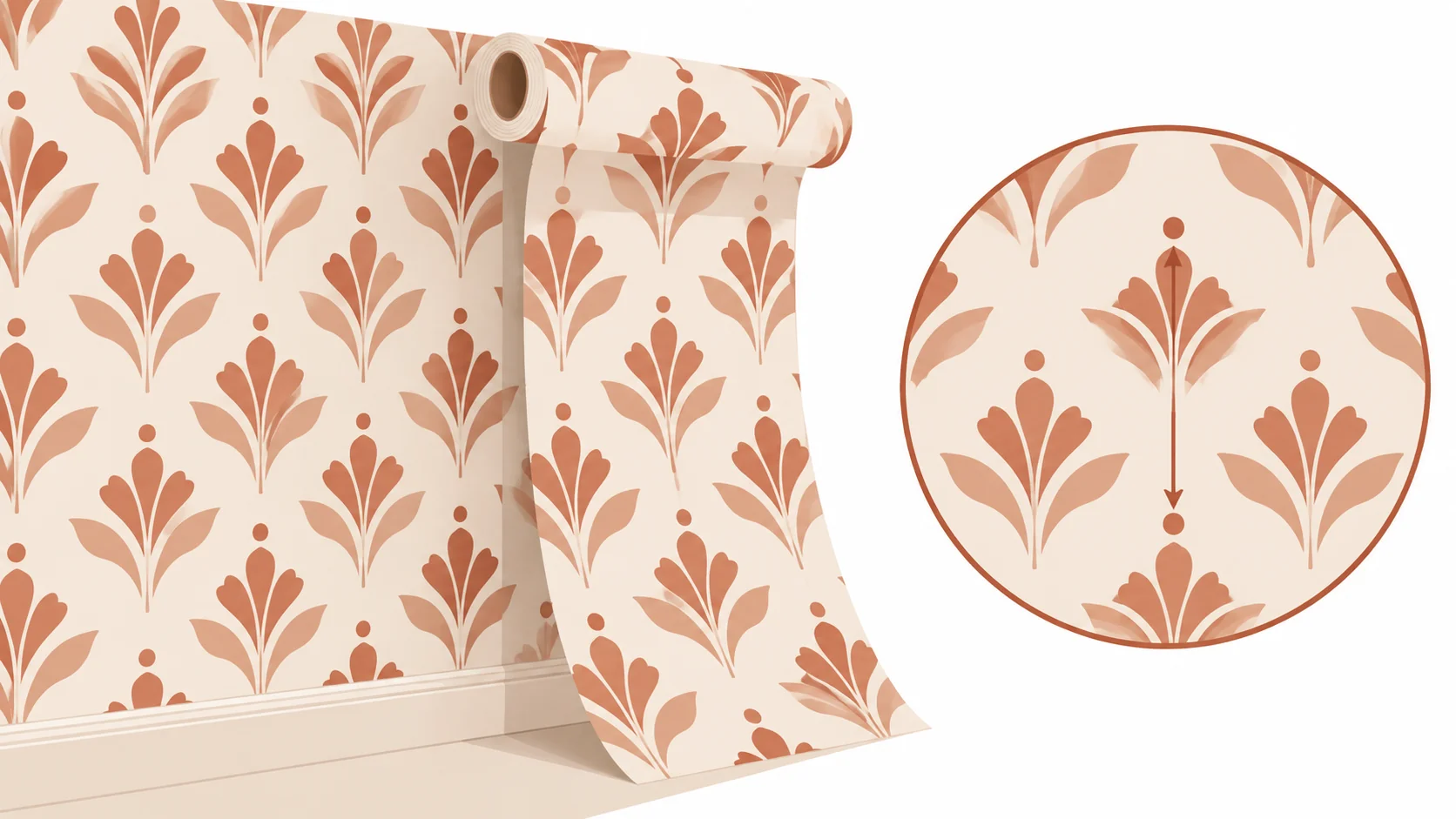
Pattern repeat refers to the vertical distance before a wallpaper’s design repeats itself. A small repeat (under 6 inches) wastes relatively little material. A large repeat (18+ inches) can waste significantly more, since each new strip has to be positioned to continue the pattern correctly, often requiring the top portion of a strip to be cut away and discarded. The Wallcoverings Association’s installation guidance explains how to read a roll’s pattern repeat measurement, usually printed directly on the label or product page.
Straight Match vs Drop Match Patterns
- Straight match: the pattern lines up horizontally across the wall at the same height on every strip, generally requiring less waste
- Drop match: the pattern alternates, requiring every other strip to shift vertically to align correctly, typically requiring more waste than a straight match pattern
Checking which type applies to a specific wallpaper before calculating rolls needed can meaningfully change your final order quantity.
Common Wallpaper Calculation Mistakes
- Ignoring pattern repeat entirely, leading to a significant shortage partway through installation
- Forgetting to order extra for future repairs, since matching dye lots can become unavailable after a product run ends
- Measuring only the primary wall area, forgetting closets, alcoves, or accent walls that need separate calculation
- Assuming all rolls are the same size, when roll dimensions actually vary meaningfully between manufacturers and product lines
Calculate exactly how many rolls you need. Use the Wallpaper Calculator →
Frequently Asked Questions
How many rolls of wallpaper do I need for a 12×10 room?
For a 12×10 room with an 8ft ceiling, standard door, and window, expect to need approximately 7 rolls of plain wallpaper or 9 rolls of patterned wallpaper, depending on the pattern repeat size.
What is pattern repeat in wallpaper?
Pattern repeat is the vertical distance before a wallpaper’s design repeats itself. Larger repeat distances require more material waste during installation, since strips need careful alignment to continue the pattern seamlessly.
Does patterned wallpaper really need more rolls than plain?
Yes, significantly more in many cases. A typical waste factor of 30% for patterned wallpaper, compared to 15% for plain wallpaper, can mean needing two or more extra rolls for the exact same room.
How much does a standard wallpaper roll cover?
A standard double roll covers roughly 56 square feet of raw material, though usable coverage after trimming and pattern matching typically runs lower, often 40–48 square feet depending on the specific pattern.
Should I order extra wallpaper for future repairs?
Yes, keeping at least one extra roll is a common recommendation, since matching the exact dye lot later can be difficult or impossible once a product run has ended.
What is the difference between straight match and drop match wallpaper?
Straight match patterns align at the same height across every strip, generally wasting less material. Drop match patterns alternate, requiring every other strip to shift vertically, typically requiring more waste to align correctly.