
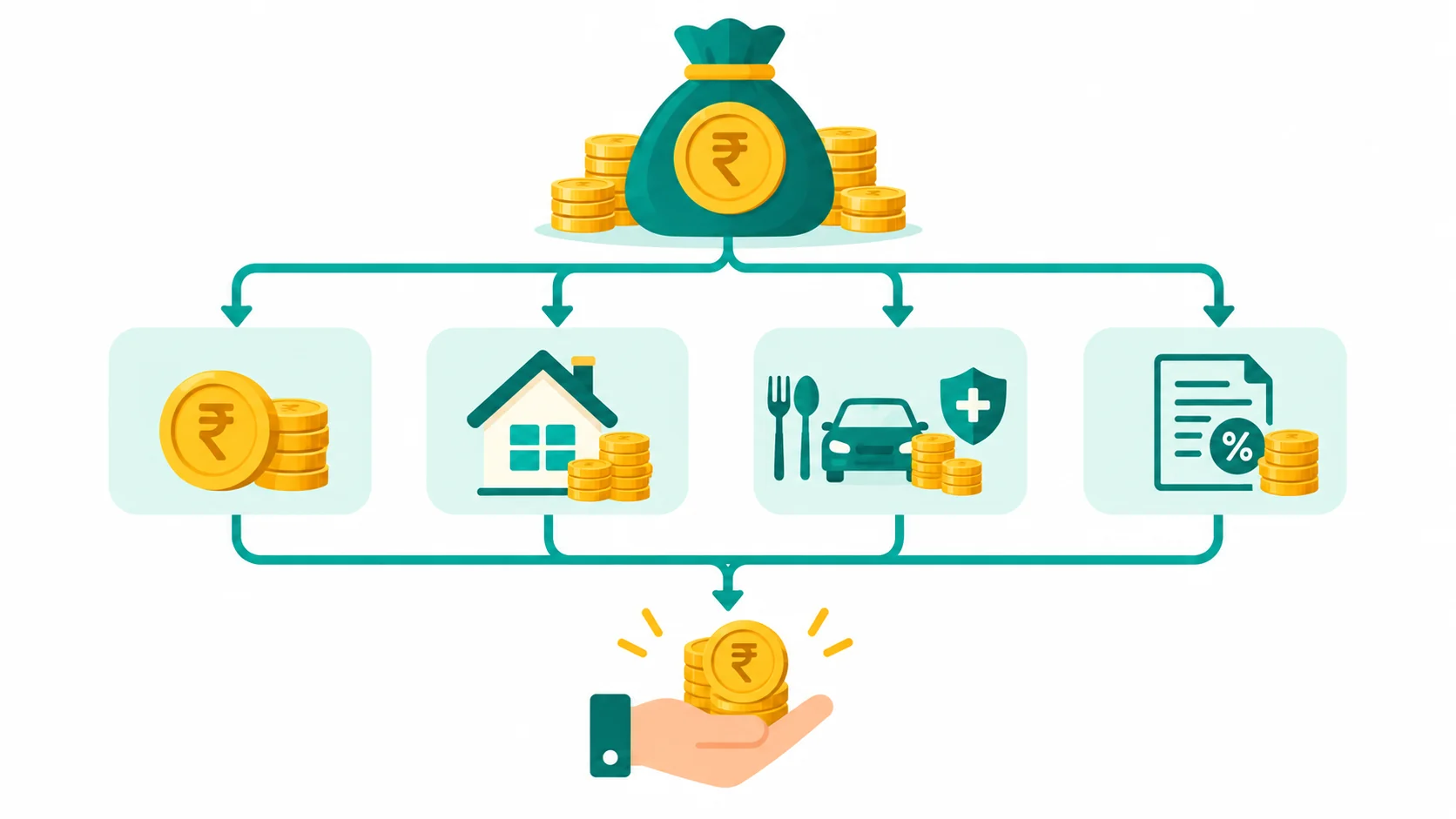
A job offer states an eighteen lakh CTC. The number that actually lands in your bank account every month is meaningfully smaller. That gap confuses almost every new employee at some point, so let’s break down exactly where the difference comes from.
What Is CTC?
CTC (Cost to Company) represents the total amount a company spends on an employee annually, including components the employee never directly receives as cash. This includes employer contributions to retirement funds and gratuity, both of which stay outside your monthly paycheck entirely.
The Main CTC Components
A typical CTC structure breaks down into several parts:
- Basic Salary: usually 40–50% of CTC, forming the base for several other calculations
- HRA (House Rent Allowance): commonly 40–50% of basic salary, partially tax-exempt if you’re renting
- Special Allowance: a flexible component that balances the CTC structure to the target total
- Employer PF Contribution: typically 12% of basic salary, paid by the employer into your retirement fund, never appearing in your monthly pay
- Gratuity: roughly 4.81% of basic salary, accrued but only paid out upon leaving after 5+ years of service
- Performance Bonus: variable, often tied to individual or company performance
Real Example: ₹18,00,000 CTC
Let’s break down a full example.
- Basic Salary: 40% of CTC = ₹7,20,000
- HRA: 50% of basic = ₹3,60,000
- Employer PF: 12% of basic = ₹86,400
- Gratuity: 4.81% of basic = ₹34,632
- Performance Bonus = ₹90,000
- Special Allowance (balancing figure) = ₹5,08,968
Gross Salary (excluding employer PF and gratuity): ₹16,78,968
This gross salary figure, not the full CTC, is what actually gets paid out monthly before deductions.
Calculating In-Hand Pay: The Deductions
From that gross salary, several deductions apply before you see your final in-hand amount.
Employee PF: 12% of basic = ₹86,400
Professional tax: ₹2,400/year (varies by state; this figure reflects a common state maximum)
Income tax under the new regime:
- Taxable income after the ₹75,000 standard deduction: ₹16,78,968 − ₹75,000 = ₹16,03,968
- Tax calculated across the FY 2025-26 new regime slabs: ₹1,20,793.60
- Since taxable income exceeds ₹12,00,000, the Section 87A rebate doesn’t apply here
- Adding 4% Health and Education Cess: ₹1,25,625.34 total tax
The Final Take-Home Number
Net take-home pay: ₹16,78,968 − ₹86,400 − ₹2,400 − ₹1,25,625.34 = ₹14,64,542.66/year
Monthly in-hand pay: ₹14,64,542.66 ÷ 12 = ~₹1,22,045/month
So from an ₹18,00,000 CTC, the actual monthly amount landing in the bank is roughly ₹1.22 lakh, a gap of nearly ₹1.35 lakh annually between the headline CTC figure and take-home pay.
Why the ₹12 Lakh Threshold Matters So Much
Under the current new tax regime, taxable income up to ₹12,00,000 (after the ₹75,000 standard deduction, effectively ₹12,75,000 in gross salary) qualifies for a full Section 87A rebate of up to ₹60,000, bringing tax liability to zero. This makes the exact structuring of a CTC package meaningfully important near that threshold, since crossing it by even a small amount removes the rebate entirely. ClearTax’s guide to the Section 87A rebate covers this threshold effect in more detail.
New Regime vs Old Regime
India currently offers two tax regimes, and employees can choose between them:
- New regime (the default): lower rates and a large standard deduction, but minimal additional deductions or exemptions available
- Old regime: higher rates, but allows deductions for items like Section 80C investments, HRA exemption calculations, and home loan interest
Someone with significant eligible deductions, particularly a home loan or substantial 80C investments, may still come out ahead under the old regime despite its higher headline rates. The Income Tax Department’s regime comparison tool helps individuals estimate which regime produces a lower tax bill for their specific situation.
Calculate your exact in-hand salary from CTC. Use the Take-Home Salary Calculator →
Frequently Asked Questions
What is the difference between CTC and in-hand salary?
CTC is the total cost to the company, including components like employer PF and gratuity that you never directly receive monthly. In-hand salary is what actually reaches your bank account after all deductions, including employee PF, professional tax, and income tax.
How much is in-hand salary for ₹18,00,000 CTC?
For an ₹18,00,000 CTC structured with typical components, monthly in-hand pay works out to approximately ₹1,22,045, after accounting for employer PF, gratuity, employee PF, professional tax, and income tax under the new regime.
Why is my in-hand salary less than my CTC divided by 12?
CTC includes employer PF contributions and gratuity, which never appear in your monthly pay, plus your gross salary itself faces further deductions for employee PF, professional tax, and income tax, all of which widen the gap between CTC and in-hand pay.
Is the new tax regime always better than the old regime?
Not necessarily. The new regime offers lower rates and a larger standard deduction, but the old regime allows significant deductions for items like home loan interest and 80C investments, which can make it more favorable for individuals with substantial eligible deductions.
What income level qualifies for zero tax under the new regime?
Taxable income up to ₹12,00,000 after the ₹75,000 standard deduction, effectively ₹12,75,000 in gross salary, qualifies for a full rebate under Section 87A, bringing the tax liability to zero under the new regime.
Does employer PF count as part of my salary?
It’s part of your CTC but not part of your take-home pay, since employer PF contributions go directly into your retirement fund rather than being paid to you as cash each month, only becoming accessible under specific withdrawal conditions.