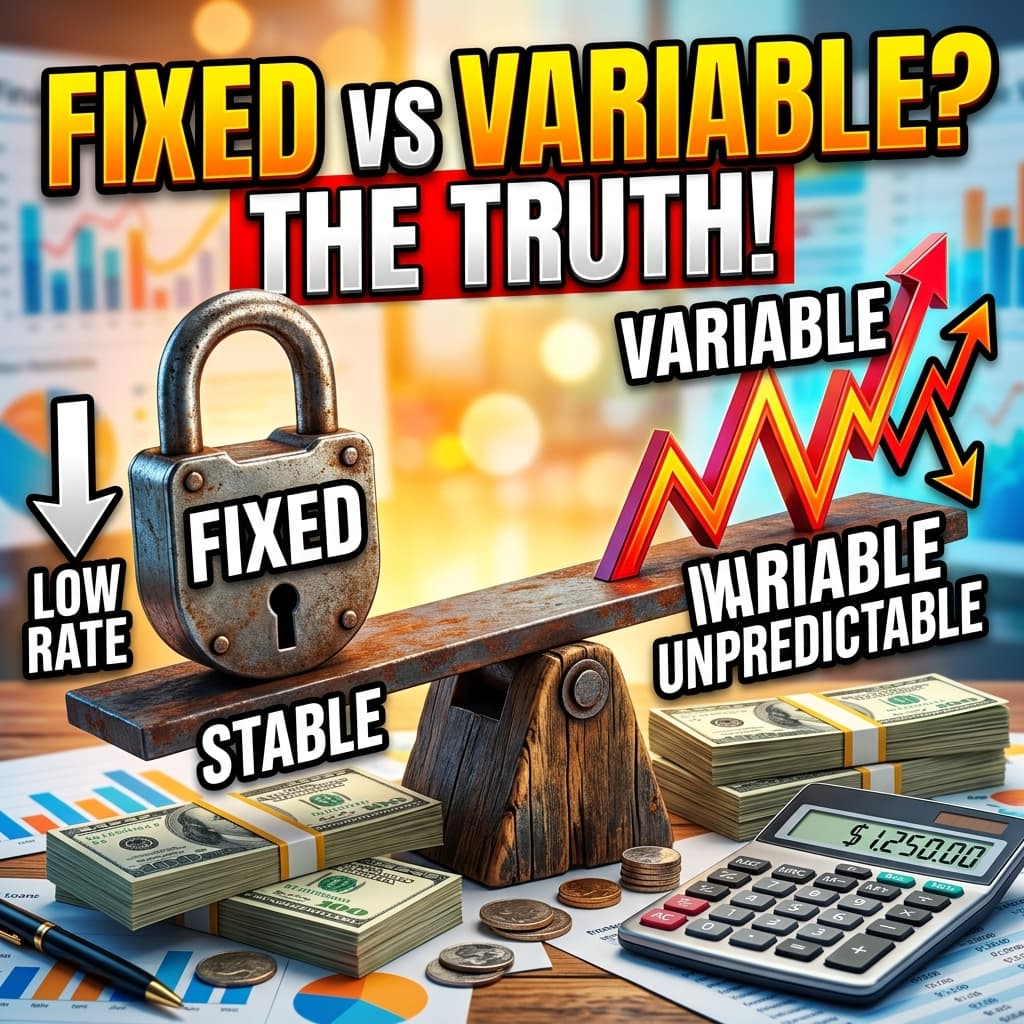
When you take out a massive loan for a house, a car, or your college education, the interest rate you receive will completely dictate your financial future. But it's not just about getting the lowest rate today; it's about predicting what that rate will do tomorrow.
Before you sign any loan documents, it is crucial to use a Loan Calculator to see exactly how your monthly payment will react under different interest rate scenarios.
The Core Concept: Fixed vs Variable
Fixed-Rate Loans: As the name implies, the interest rate is locked in for the entire life of the loan. If you lock in a 5% rate on a 30-year mortgage today, your interest rate will still be 5% in the year 2056, regardless of what the economy does.
- Pros: Predictable monthly payments, protection against inflation, peace of mind.
- Cons: The starting rate is usually higher than a variable rate loan.
Variable-Rate Loans (or Adjustable Rate): The interest rate fluctuates based on an underlying benchmark index (like the Prime Rate). When the Federal Reserve raises rates to fight inflation, your loan's interest rate automatically goes up, and your monthly payment increases.
- Pros: Lower initial interest rates (often called a "teaser rate").
- Cons: Extreme unpredictability. Your payment could skyrocket if the economy shifts.
Real-World Example: The Adjustable Rate Trap
Let's look at a $300,000 mortgage. You are offered a Fixed 30-Year at 6.0%, or a 5/1 Adjustable Rate Mortgage (ARM) starting at 4.5% for the first five years, after which it adjusts annually.
| Loan Type | Initial Monthly Payment | Payment in Year 6 (If Rates Jump to 8%) | |---|---|---| | Fixed Rate (6.0%) | $1,798 | $1,798 | | Variable Rate (4.5% ➡️ 8.0%) | $1,520 | $2,118 |
The variable rate looked like a steal for the first five years, saving you almost $300 a month. But in Year 6, a massive rate hike causes your monthly payment to shoot up by $600.
(If you are trapped in a high-rate personal loan, you might want to look into consolidation. Run your numbers through our Personal Loan Calculator or see how fast you can aggressively pay it down using our Loan Payoff Calculator).
Common Mistakes to Avoid
[!WARNING] Assuming Rates Will Always Stay Low: Following the 2008 financial crisis, interest rates stayed near 0% for over a decade. Millions of people took out variable-rate student loans and mortgages assuming rates would never rise. When inflation hit in the 2020s and rates spiked to 7%, those borrowers were financially devastated. Always plan for a worst-case scenario.
People Also Ask (FAQ)
When does a variable rate make sense?
A variable rate is an excellent choice if you plan to pay off the loan very quickly. For example, if you are flipping a house and only intend to hold the mortgage for 12 months, taking the ultra-low variable rate saves you money, and you sell the house long before the rate has a chance to adjust upward.
Can I change a variable rate to a fixed rate?
Yes, but you have to refinance the entire loan. Refinancing requires a new credit check, new origination fees, and closing costs (which can be thousands of dollars). Furthermore, if you wait to refinance until after rates have already gone up, you will be locking in a new, higher fixed rate anyway.
What about credit cards?
Almost all credit cards in the United States have variable interest rates. When the Prime Rate goes up, your credit card APR instantly goes up. This is why credit card debt is the most dangerous debt to hold.
Final Takeaway
If you value sleep, stability, and predictable budgeting, always choose a fixed-rate loan. The slight premium you pay upfront is the cost of financial insurance against a volatile economy. Compare different fixed rates today using our Loan Calculator.
Tags