
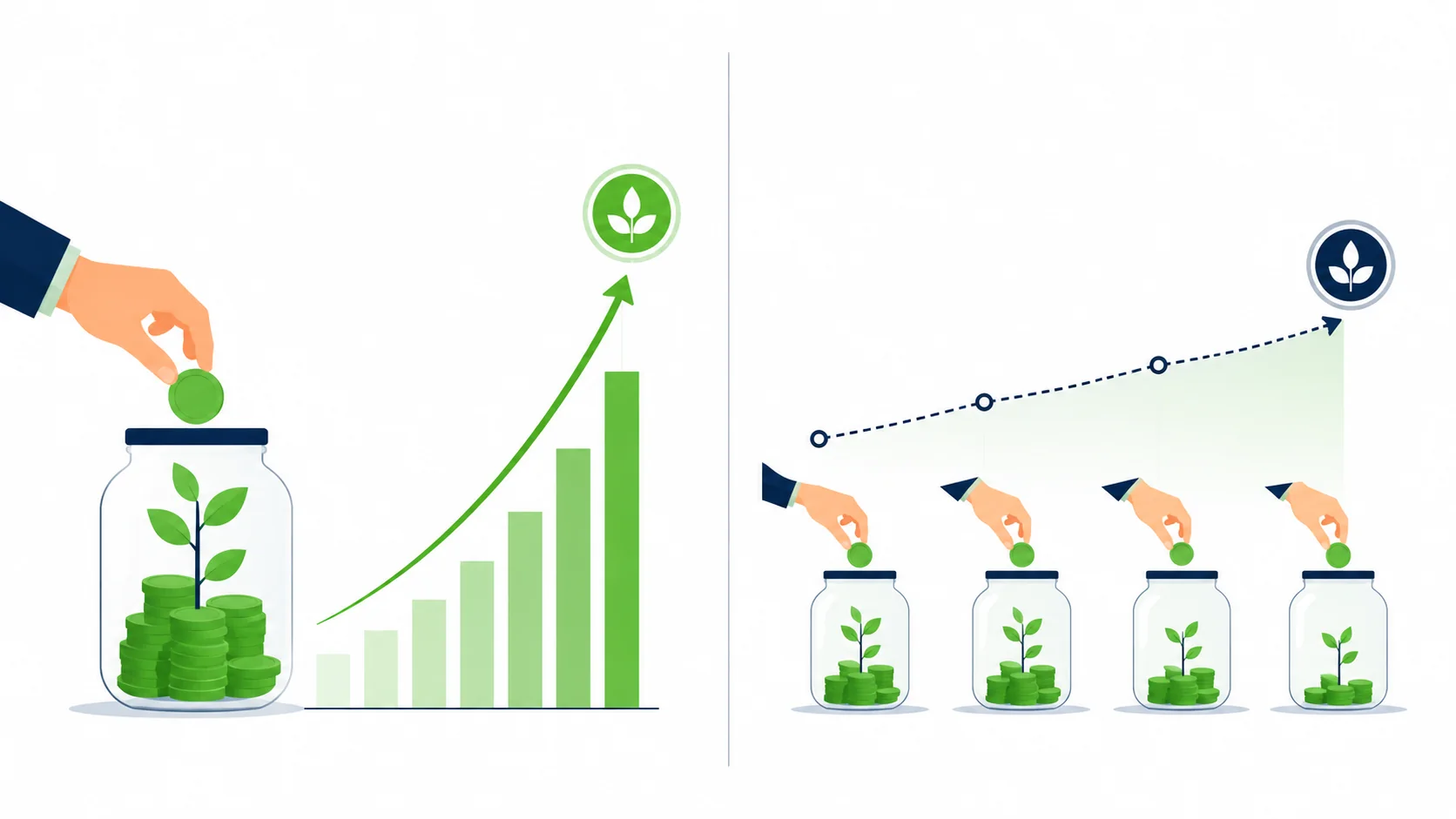
A windfall lands in your account. Maybe it’s an inheritance, a bonus, or a settlement. Now comes the decision: invest it all right now, or spread it out gradually over time? The math has a clear answer, though the emotional case runs the other way. Here’s both sides.
The Lump Sum Formula
Future Value = Principal × (1 + r)^t
Real Example: $25,000 Invested at Once, 8% Annual Return, 15 Years
Let’s calculate.
- Lump sum: $25,000
- Annual return: 8%
- Time period: 15 years
Future value: $25,000 × (1.08)^15 = $79,304.23
Comparing to Spreading the Same $25,000 Monthly
Now let’s spread that identical $25,000 evenly across the same 15-year period instead, investing roughly $139/month rather than all at once.
Monthly contribution: $25,000 ÷ 180 months = ~$139/month
Future value of monthly contributions at 8%: $48,060.86
The Surprising Gap
Investing the full $25,000 immediately produced $79,304.23. Spreading that same $25,000 out monthly over 15 years produced only $48,060.86. That’s a difference of over $31,000, purely from timing.
So why such a massive gap? Because the lump sum starts compounding on the full amount from day one. The spread-out approach only invests small amounts gradually, meaning most of the money spends years sitting uninvested, missing out on growth it could have been earning. Vanguard’s own research on lump sum versus dollar-cost averaging has repeatedly found that investing a lump sum immediately outperforms spreading it out roughly two-thirds of the time historically, specifically because markets trend upward more often than they decline.
So Why Would Anyone Choose to Spread It Out?
The math clearly favors lump sum investing on average. But averages aren’t guarantees for any single individual investor. If you invest a large lump sum right before a significant market downturn, the emotional and financial impact can be severe, even if markets eventually recover. Dollar-cost averaging, spreading investments out over time, reduces that specific risk by buying at a mix of prices rather than one single point in time. Fidelity’s guide to dollar-cost averaging frames this trade-off honestly: it’s a behavioral risk-management tool, not a strategy that beats lump sum investing on pure expected return.
A Middle-Ground Approach
Some investors split the difference, investing a portion as a lump sum immediately and spreading the remainder over a shorter period, like 3–6 months, rather than committing to either extreme. This captures much of the lump sum’s return advantage while still smoothing out some near-term timing risk, which can matter more for peace of mind than for the actual expected outcome.
When Dollar-Cost Averaging Makes More Sense
- Ongoing income, like regular paycheck contributions to a 401(k), where there’s no real lump sum choice available in the first place
- High market valuations, where an investor’s personal risk tolerance genuinely can’t handle a hypothetical near-term drop on the full amount
- Psychological comfort, since sticking with a plan matters more than optimizing for a small statistical edge if the alternative is panic-selling during a downturn
Compare your own lump sum vs monthly investment scenario. Use the Lump Sum Calculator →
Frequently Asked Questions
Is lump sum investing better than dollar-cost averaging?
Historically, yes, on average, since lump sum investing has outperformed spreading investments out over time in roughly two-thirds of historical periods, mainly because markets trend upward more often than they decline.
How much does timing actually matter for investing?
Significantly, especially for larger amounts and longer time horizons. In our example, the same $25,000 produced a difference of over $31,000 in future value purely based on whether it was invested immediately or spread out monthly.
Why would someone choose dollar-cost averaging if lump sum wins on average?
Dollar-cost averaging reduces the emotional and financial risk of investing right before a downturn, which matters for investors who might otherwise panic-sell, even though it typically produces a lower expected return than investing immediately.
Can I combine lump sum and dollar-cost averaging strategies?
Yes, many investors split a windfall, investing a portion immediately as a lump sum and spreading the remainder over a shorter period, like a few months, balancing expected return against near-term timing risk.
Does dollar-cost averaging guarantee lower risk?
It reduces the specific risk of poor timing on a single large investment, but it doesn’t eliminate market risk entirely, since the invested portions still face ongoing market fluctuations throughout the spread-out period.
What return rate should I use for lump sum planning?
Many long-term investors use 7–10% as a reasonable estimate for a diversified stock-heavy portfolio, based on historical long-term averages, though actual future returns are never guaranteed and vary significantly year to year.
I am actually thankful to the holder of this web site who
has shared this enormous article at here.
We are a group of volunteers and starting a new scheme in our community.
Your site provided us with helpful information to work on. You’ve done a
formidable process and our whole neighborhood can be thankful to you.
Cool blog! Is your theme custom made or did you download it from somewhere?
A theme like yours with a few simple adjustements would really make my blog shine.
Please let me know where you got your theme. Bless you
its a basic free theme we customized it how we want
Magnificent beat ! I wish to apprentice while you amend your
site, how can i subscribe for a blog site? The account helped me a acceptable deal.
I had been a little bit acquainted of this your broadcast provided bright clear idea
It’s awesome for me to have a web page, which is beneficial for my experience.
thanks admin
Great website. A lot of helpful information here.
I’m sending it to several friends ans also sharing in delicious.
And naturally, thank you to your effort!